
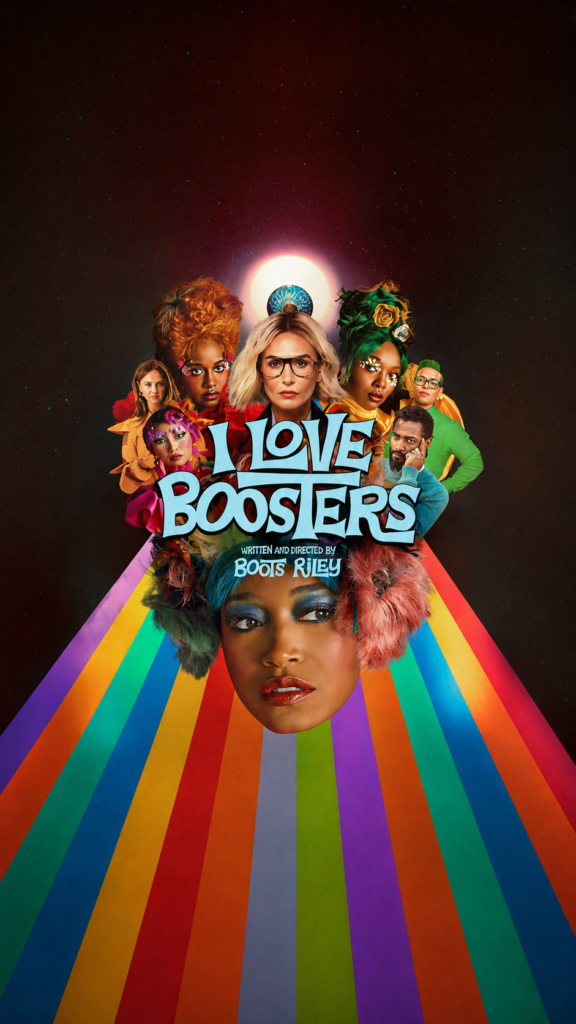
I Love Boosters (2026)
| Details | Information |
|---|---|
| Movie Name | I Love Boosters |
| Time | 115 minutes |
| Release Date | June 23, 2026 |
| Language | English |
| Genre | Comedy, crime, adventure, and science fiction |
| 🔞UA | 16+ |
Quick Movie Details
| Detail | Information |
|---|---|
| Movie | I Love Boosters |
| Director and writer | Boots Riley |
| Main cast | Keke Palmer, Naomi Ackie, Taylour Paige, Poppy Liu, Eiza González, Demi Moore, LaKeith Stanfield, Will Poulter and Don Cheadle |
| Genre | Comedy, crime, adventure, and science fiction |
| Country | United States |
| Language | English |
| U.S. release date | May 22, 2026 |
| Digital release | June 23, 2026 |
| Runtime | About 105 to 115 minutes, depending on the platform listing |
| Age rating | R |
| Distributor | NEON |
Is I Love Boosters Worth Watching?
I Love Boosters is bright, angry, funny and proudly strange.
Boots Riley does not make a normal heist movie. He uses stolen designer clothes, wild science-fiction ideas and sharp comedy to talk about money, workers’ rights and the power of big companies.
The film has a lot to say. Sometimes, it may have too much to say at once.
Still, it rarely feels boring. Keke Palmer brings real energy to the lead role, while Demi Moore makes the fashion world feel cold, powerful, and dangerous. Viewers who enjoy bold satire will probably have a good time. People looking for a simple crime comedy may feel lost.
What Is I Love Boosters About?
Keke Palmer plays Corvette, a talented designer and the leader of the Velvet Gang.
The group earns money by stealing expensive clothing and selling it to ordinary people at lower prices. They call their work a form of community service. It is illegal, of course, but the crew believes the fashion system is already unfair.
Their biggest problem arrives when famous fashion leader Christie Smith, played by Demi Moore, takes one of Corvette’s designs.
Corvette and her friends decide to fight back. Their plan is not small. They want to steal Christie’s entire clothing collection.
What begins as a personal act of revenge soon becomes much bigger. Retail workers and factory workers start questioning the system around them, turning the gang’s fashion heist into a wider labor movement.
Keke Palmer Gives the Film Its Heart
Corvette is not written as a perfect hero. She is clever, stylish, and brave, but she can also be proud and reckless. Her anger makes sense because Christie Smith has taken something personal from her. At the same time, her choices place the whole Velvet Gang in danger.
Keke Palmer carries these different sides well.
She can move from a serious political speech to a ridiculous comedy scene without making Corvette feel like two separate characters. Palmer gives the film its confidence, but she also helps us see the fear hiding under Corvette’s bold image.
Boots Riley has praised Palmer’s comic ability, while Taylour Paige has spoken about how much the cast laughed together during filming. The actors also described the independent production as demanding, with long shooting days in the Bay Area and Atlanta.
The Velvet Gang Feels Like a Real Team
Naomi Ackie, Taylour Paige, Poppy Liu and Eiza González help make the Velvet Gang more than a group standing behind the main character.
Each member brings a different mood.
Some are careful. Some are ready to fight. Others seem more interested in style, fun or survival. Their small disagreements help the group feel alive.
The friendship between the women is also important. The movie is full of big political ideas, but it works best when it slows down and lets the gang talk, joke, or argue with one another.
Without that bond, the film could have felt like a long speech about capitalism. The cast gives it warmth.
Demi Moore Makes Christie Smith More Than a Simple Villain
Christie Smith is the face of the luxury fashion system.
She sells beauty, success, and status. Behind that polished image is a business built on control and unfair working conditions.
Demi Moore plays Christie with a calm, distant style. She does not need to shout in every scene. Her power comes from knowing that money, fame, and the business world are already on her side.
This creates a strong contrast with Corvette.
Corvette has ideas but little money. Christie has money and the power to take other people’s ideas. Their fight is not only about one stolen design. It is about who gets credit, who earns the profit, and who remains invisible.
A Heist Movie That Refuses to Follow the Rules
A normal heist film spends time explaining the plan.
The crew studies a building. Everyone receives a job. Something goes wrong, and the team must think fast.
I Love Boosters starts with that basic idea, then throws the rulebook away.
The movie adds strange technology, cartoon-like movement, wild costumes and sudden changes in tone. It can move from a serious conversation about factory workers to a visual joke that makes almost no logical sense.
That may sound messy because it is messy.
Yet much of the fun comes from not knowing what Riley will place on the screen next. Published reviews have praised the film’s originality and visual confidence, while some critics have argued that its cartoon style weakens the emotional stakes.
Fashion Is More Than Decoration
Clothing is part of the story, not just something the actors wear.
For Corvette and the Velvet Gang, fashion is a way to build an identity. Their outfits help them feel seen in a world where wealth often decides whose work matters.
For Christie Smith, fashion is a business and a source of power.
The film keeps asking a simple question: Why should one person charge a huge price for clothing made by workers who receive so little?
Boots Riley has explained that the movie is not attacking fashion itself. His larger target is the unfair way wealth is shared. The story was also inspired by “I Love Boosters,” a song connected to Riley’s hip-hop group, The Coup.
Bright Visuals Hide an Angry Story
Cinematographer Natasha Braier fills the film with strong shapes, rich clothing, and glossy stores.
At first, the fashion world looks exciting. The shops are clean, colorful, and full of beautiful things. But the more time we spend inside this world, the less friendly it feels.
The stores begin to look like guarded spaces where only wealthy people truly belong.
Corvette and the Velvet Gang break that perfect image. They run, hide, steal, and bring disorder into places designed to feel controlled.
Braier’s cinematography, the costume work and the unusual production design turn the fashion industry into its own strange universe. The film was photographed digitally and presented in a wide 2.39:1 format.
Music Keeps the Movie Moving
The music comes from Merrill Garbus and Nate Brenner of Tune-Yards.
Their score is busy, playful and sometimes rough. Instead of quietly sitting behind the action, it often pushes the scenes forward.
This fits the film’s restless mood.
During the shoplifting scenes, the music can make the gang’s movement feel like a dance. During stranger moments, it adds to the feeling that the movie could fall apart at any second.
That energy helps the film, although viewers who prefer calm storytelling may find the sound and visuals tiring after a while.
Where the Film Struggles
The biggest problem is not a lack of ideas. It is the huge number of ideas fighting for space.
The movie wants to discuss fashion, class, labor, ownership, consumerism, friendship and creative theft. It also wants to be a crime comedy, a science-fiction story and a strange cartoon brought to life.
Not every part fits.
Some characters disappear for too long. A few speeches explain points the audience may already understand. The film can also jump away from an emotional scene before it has time to settle.
This is where viewers may split.
One person may see a fearless movie that refuses to play safe. Someone else may see a noisy story that needed stronger editing.
Both reactions are fair.
Is I Love Boosters Suitable for Children?
No. This is an adult comedy.
The Motion Picture Association rated the movie R for strong sexual content, nudity, frequent language and brief drug use. Parents should not rely on its colorful look or playful title when deciding whether it is suitable for younger viewers.
I Love Boosters Ending Explained
Major spoilers begin here.
The ending shows that the Velvet Gang’s fight has grown beyond stolen clothes.
Factory workers in China and employees at Metro Designers begin a general strike. The action spreads, placing real pressure on Christie Smith and the companies connected to her fashion empire.
Christie is forced to improve conditions in her stores and factories.
This matters because Corvette cannot defeat the system alone. Stealing expensive clothing may embarrass Christie, but it does not change who owns the factories or who controls the money.
The strike does.
The final message is about collective power. Corvette and her crew begin the disruption, but workers create lasting change by acting together. That ending fits Riley’s larger focus on labor movements and solidarity.
The film does not say that every problem is solved. Powerful companies can adjust, protect themselves and sell rebellion back to the public. However, the workers prove that the system is not impossible to challenge.
Final Verdict
I Love Boosters is not a neat movie, and it does not want to be one.
It is loud, strange and packed with political anger. Some jokes land perfectly. Others may leave viewers wondering what they just watched.
Keke Palmer holds the chaos together with a funny and confident performance. Naomi Ackie, Taylour Paige, Poppy Liu and Eiza González give the Velvet Gang real personality, while Demi Moore makes Christie Smith a polished symbol of corporate power.
The movie works best when its wild images and serious ideas support each other. It struggles when the message becomes louder than the characters.
Even with those problems, it feels different from most modern crime comedies. Boots Riley has made a fashion heist that is really about work, ownership and who gets to enjoy the things society creates.
Read More: Little Brother (2026)